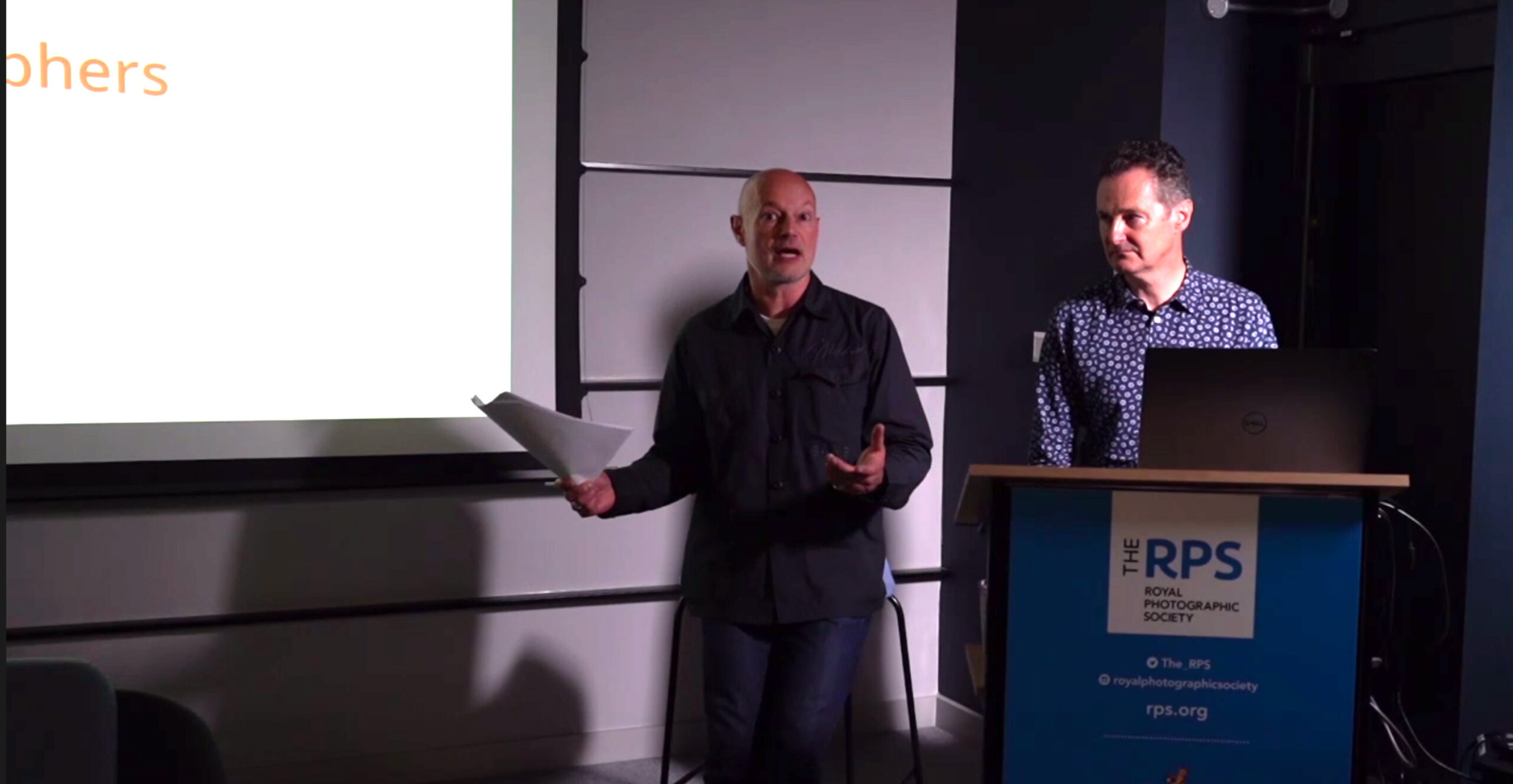
RPS, 9-10 October 2023
‘How might we imagine the future of photography without photographers?’ asked Katrina Sluis in the Keynote of this two-day seminar on photography and AI.
Perhaps a reasonable question to ask when a simple text prompt placed into Dall-E, MidJourney or Stable Diffusion can generate virtually any image on demand. Depending on who you believe, these tools are portents to an exciting future, or sound the death knell for photography as we know it.
Which is right? Or is the truth somewhere in between? This two-day seminar hosted by the Royal Photographic Society aimed to find out.
Simon Hill HonFRPS, RPS President, opened with an optimistic note. Photography has had five seismic events, he reminded us, and it has adapted, emerging stronger from each one. The first three: the Camera Obscura; the use of lenses and the fixing of a permanent image by Daguerre and Fox Talbot in the 19th century, enabled photography as we know it. Next, the early 20th century brought the democratisation of photography thanks to Kodak. Finally, the 1990s brought digital imaging. I remember similar anguished hand-wringing back then about how digital image manipulation was destroying photography just as AI is doing now. So are the doom-mongers overplaying their hand? AI does bring complex new challenges around ownership and copyright. Has photographic ‘truth’ (that utopian ideal which never actually existed) been dealt the final killer blow by AI?
Thinking about the elaborate works of Gregory Crewdson, It certainly looks harder to justify costly tableaux when they can be created with a simple click of a mouse instead.
Hill drew comparisons with Paul Delaroche’s famous exclamation ‘painting is dead!’ upon hearing of photography in 1840. With hindsight, arguably the converse was truer: by abandoning the relentless quest for perfect visual reproduction, painting became free to explore exciting new creative directions such as cubism.
But if there’s confidence that photography will adapt and survive, the seminar also acknowledged that things would definitely change. They already have. The proverbial genie is out of the developer bottle. We must therefore understand it, define it, work with it. Perhaps we need then to reaffirm the boundaries of what is a photograph.
Speaker Dr Subhankar Poddar reminded us that the compound word ‘photo’-‘graph’ means ‘painting’ with ‘light’. The image is formed by light, reflected off some physical object, falling onto a light-sensitive material or sensor. An AI image is not based on any ‘That has been’ (to quote Barthes). It is born from a word prompt instead. A boundary of sorts. Is it time for a new term: Promptography? Arguments were made that we need to differentiate the photograph from the generative image for credibility, trust and truth and to protect what we understand photography to be, distinct from this new kid in town. One audience member suggested we should not use ‘image’ any longer, reserving that word for AI generative work, leaving ‘photograph’ for light-derived images only.
That’s all well and good. But what if everyone doesn’t play by the rules? Natasha Hirst of the NUJ gave a disturbing reflection on the risks and impacts we are already seeing in journalism. Tim Dunmur of AoP explained how his own work had been extensively ‘scraped’ by the learning algorithms.
Boris Eldagsen (who was present) famously caused controversy at this year’s Sony Press Photography Award with The Electrician – a winning image which he revealed to be Generative AI afterwards, and so did not accept the award. The startling thing was how the judges did not realise it was an AI image until afterwards. An unscrupulous image-maker might instead have kept quiet. Some present suggested submission of RAW files or negatives to ‘authenticate’ an image as a photograph. Another, offered a mark on each (presumably in EXIF) to differentiate. Lots to consider…and lots for bad actors to potentially subvert (have we been dealing with this issue since we saw the Cottingley Fairies a century ago?).
And where is the line to be drawn? Photoshop now includes a generative AI tool to add or remove objects. Old boyfriend on the wedding photo? Aardvark in flip-flops missing from your family snapshot? No longer a problem. But is that still a photograph afterwards? An image? CGI? Mixed media? Professor Shawn Sobers and Yoko Edwards of Bristol University also highlighted some of the inherent biases within generative AI, so there’s a whole new minefield to beware of now.
Dr Grant Scott (Senior lecturer at Oxford Brookes; United Nations of Photography podcast) suggested we should all dial down the apocalyptic talk. Citing drum machines in the 1980s, he reminded us that real drummers indeed still exist (in fact, having a counter-resurgence in the 1990s as the musical subversion was subverted). AI will change photography, yes. But it won’t die. commissions will always want their real product represented. But he encouraged us to consider convergence, convergence of content rather than separate stock, video or still images. Photographers need to discover the ‘video’ button on their DSLRs! Lose the old labels, for ourselves and our work categorisation. Is it Commercial or Art? Really, it’s all a ‘commission’ for somebody.
Ultimately, what kept coming up for me was the inherent paradoxical truth of a photograph. We want to believe that the camera never lies because our brains like something solid to hang onto. But we are all now visually literate enough to know that the photograph fibs a bit too. To paraphrase Coleman (1967), all photographs are fiction…whether we are prepared to acknowledge it or not. In this respect, AI brings nothing new, a mere extension of the fiction part. For documentary work, this is a major concern. We can use the camera to document, but also to create. That’s what makes a photograph uniquely engaging to me – it offers an infinitely variable blend of reality mixed with the photographer’s own creativity. But Barthes’ seed of ‘that which was’ will always reside within it, small or large. With a generative image, that’s entirely absent. For me, that’s the magical bit.
Very interesting article Ian.