
One marvelous thing about photography is how it reveals our very different ways of seeing the world, and tell our unique story in our own way.
Last week I was walking in a familiar Derby park. I noted the shimmer of late summer sun reflecting off the river Derwent. A heron flew overhead. Then a v-formation of geese, embarking on their long winter getaway. Everywhere I looked I saw green: the endless grass, oaks still majestic in full leaf, moss on their northern trunks, sycamore and beech. Everywhere, that is, except for the horse chestnuts, whose leaves had already detected the subtle change in the air, leaves tinged brown, a foretelling of autumn.
The high-rise buildings of Derby loomed over us to the south, the city’s flood defences standing as erect guardians between them and me. I felt like I was in the city’s own backyard, sharing this space with rowers and runners, all moving through the space faster than I.
Another viewpoint
My walking companion, conversely, noted a discarded drink bottle. The area was generally clean and tidy, but this stood out to him like a drop of merlot on a new, white tablecloth.
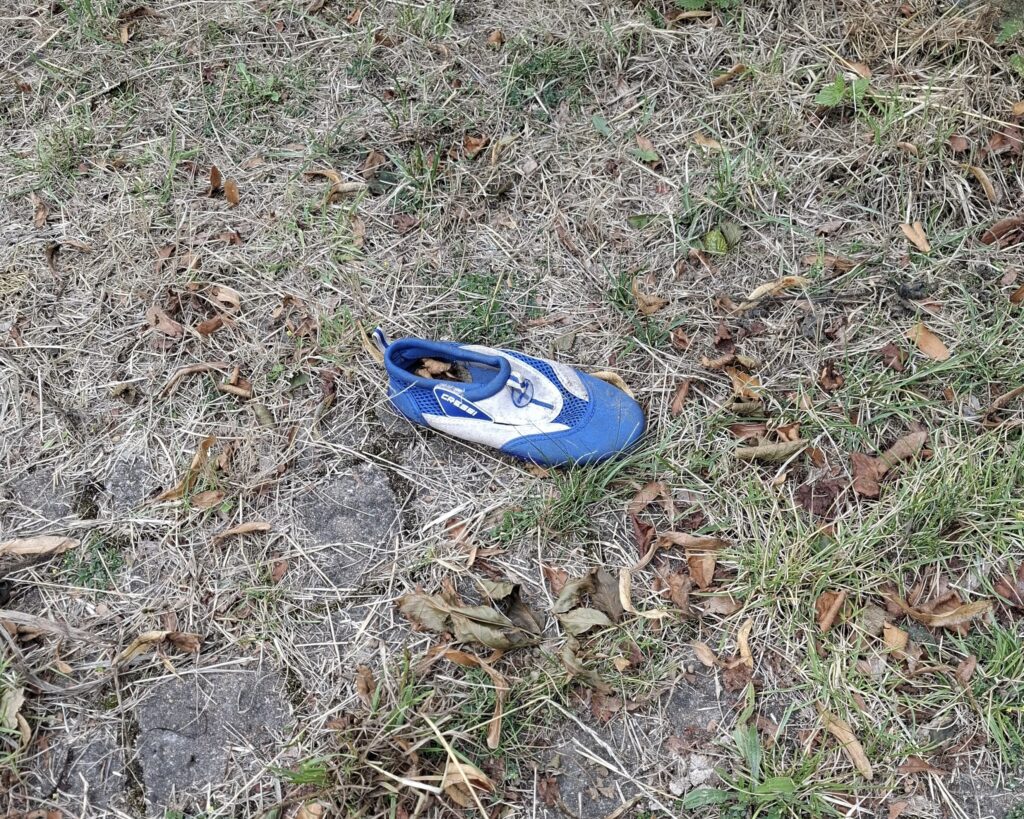
As we walked further, he homed in on a discarded Double Decker (NB. other chocolates are available) wrapper. An empty crisp (NB, not ‘chips‘) packet. Even a small child’s shoe (how can you not miss that?).
He built an entire narrative about the impact of the city on the environment, not just visually looming over us on the horizon, but also spreading its detritus out into the rural suburbs. I’d seen past these everyday items, but he hadn’t.
Visual storytelling
One of the reasons we were there was that my companion was keen to learn about photography as a language and visual storytelling. We explored how we could communicate stories visually with multiple images without using words, and how the sequencing of these images might change the narrative he was seeking to portray.
Sequence 1. A city shot: Clearly points out the origin of the litter, followed by images of the discarded items. This speaks of the city ‘leeching out’ into other areas, with a seemingly endless impact.
Sequence 2. But what about the other way around? Wrapper. Bottle. Wrapper. Shoe…then city. We liked the immediate sense of rhythm to the dropping of litter: “Step, drop, step, drop. Hang on – what’s this? A city? Aha – that’s what’s causing it”. There’s more of a ‘reveal’ to this simple story now. A twist. But it also risks viewer fatigue. Would they ever get to the end? After all, who wants to look at endless images of rubbish?
And what about the discarded shoe? To include or exclude? It’s curious and interesting. Yet it dilutes the narrative, as we then start to wonder about its own story instead. If we leave out the cityscape, how does the narrative change? Do we now assume the mystery shoe-loser is the sole litterlout?


Show not tell
My companion had picked up on a theme that I’d not seen in my mind’s eye until he pointed it out. Similarly, he hadn’t noticed the subtle slowing of summer that I had. The same experience had been interpreted in a wholly different way. That’s not so surprising – we are all wired differently, after all.
What was so interesting to me was how he could then tell such very different stories by just changing the order of the images, using only his images, not words.
Had we discussed this in words, I’m sure we’d have used phrases like ‘But did you notice…?’ And ‘I thought it was actually more like this…’ But storytelling allows us to show, don’t tell.
Facing troubles
Donovan Wylie is a photographer from Belfast who did this to great effect in his 2007 work British Watchtowers. He photographed the locations of British army watchtowers from The Troubles, shortly before they were dismantled as part of the peace process.
The work delivers a powerful message regarding their purpose and use. The series of images underline the omnipresence of the towers as we imagine them looking down on residents. Yet by showing us photographs taken after the events, there is a distance created. We are reflecting upon the human experience of what happened there, not forced to be involved in it directly, not forced to choose a side.
Visual storytelling with photography offers endless possibilities for self-expression. It can also be less adversarial than using words, leaving space to insert our own opinions as a viewer. Words can often provoke an instant defence, a rebuttal, a desire ‘to be right’. But delivering powerful messages with less confrontation is something the world needs more of right now, I’m sure you’d agree.
Your blog today, brought straight to mind the lyrics of a favourite song of mine.
How many times do you hear it?
It goes on all day long,
Everyone knows everything,
And no one’s ever wrong,
Until later.
Who can you believe?
It’s hard to play it safe,
But apart from a few good friends,
We don’t take anything on faith
Until later.
Show…don’t tell…
(Show me, don’t tell me)
You’ve figured out the score,
(Show me, don’t tell me)
I’ve heard it all before,
(Show me, don’t tell me)
I don’t care what you say,
(Show me, don’t tell me)
You can twist perceptions,
Reality won’t budge,
You can raise objections,
I will be the judge,
And the jury.
I’ll give it due reflection,
Watching from the fence,
Give the jury direction.
Based on the evidence
I, the jury.
(Show me, don’t tell me)
Hey, order in the court,
(Show me, don’t tell me)
Let’s try to keep it short,
(Show me, don’t tell me)
Enough of your demands,
(Show me, don’t tell me)
Witness take the stand,
(Show me, don’t tell me)
(Show me, don’t tell me)
Hey, order in the court,
(Show me, don’t tell me)
Let’s try to keep it short,
(Show me, don’t tell me)
I don’t care what you say,
(Show me, don’t tell me)
(lyrics by Neil Peart)
Some references to magistrates too I believe…
Most apt.
I had you in mind for this one Bill after our conversation last week. Glad you enjoyed it. Oh, and Rush?
Yes Ian I would absolutely agree. I love the sequencing experiment – something I struggle with all the time.
It always makes me reflect on how the news is doing this to us every day Nuala.